
Social Responsibility
Occupational Safety & Health

Talent management is a key enabler of QL’s long-term growth, operational resilience and sustainable value creation across our diverse business pillars. A capable, engaged and future-ready workforce enhances productivity, supports innovation and strengthen our ability to adapt to evolving business and industry demands.
At the same time, effective talent strategies mitigate workforce-related risks, including skills gaps, high turnover and leadership succession challenges, while reinforcing service quality and operational continuity across all business pillars.
By investing in continuous capability development, leadership pipeline building and a positive employee experience, we foster a resilient, high-performing workforce that strengthens organisational culture, supports responsible business practices and enables sustainable outcomes for employees, shareholders and broader stakeholders.
At QL, the safety, health and well-being of our employees, contractors, and business partners are fundamental to how we operate. Our Occupational Safety and Health Policy accentuate the preservation of a safe and healthy work environment, the prevention of occupational illness or injury, integrating safety and health to protect the people at work. Guided by leadership at all levels, we cultivate a proactive safety culture, reinforce clear accountabilities and continuously strengthen our occupational safety and health (OSH) practices.
We adopt a disciplined approach anchored in data driven decision-making, robust performance monitoring and early intervention. Beyond regulatory compliance, we align with internationally recognised standards such as ISO 45001:2018 to enhance the maturity of our OSH management systems and drive sustainable operational performance.
Through this integrated approach, we aim to provide a safe, healthy and conducive work environment that supports the wellbeing of our workforce while enabling operational excellence.
Our Target
- Zero fatality
- LTIFR: 2.98
FY2026 Performance
- Two work-related fatalities were recorded during FY2026, both occurring off-site
- Achieved an LTIFR of 2.77, exceeding the FY2026 target
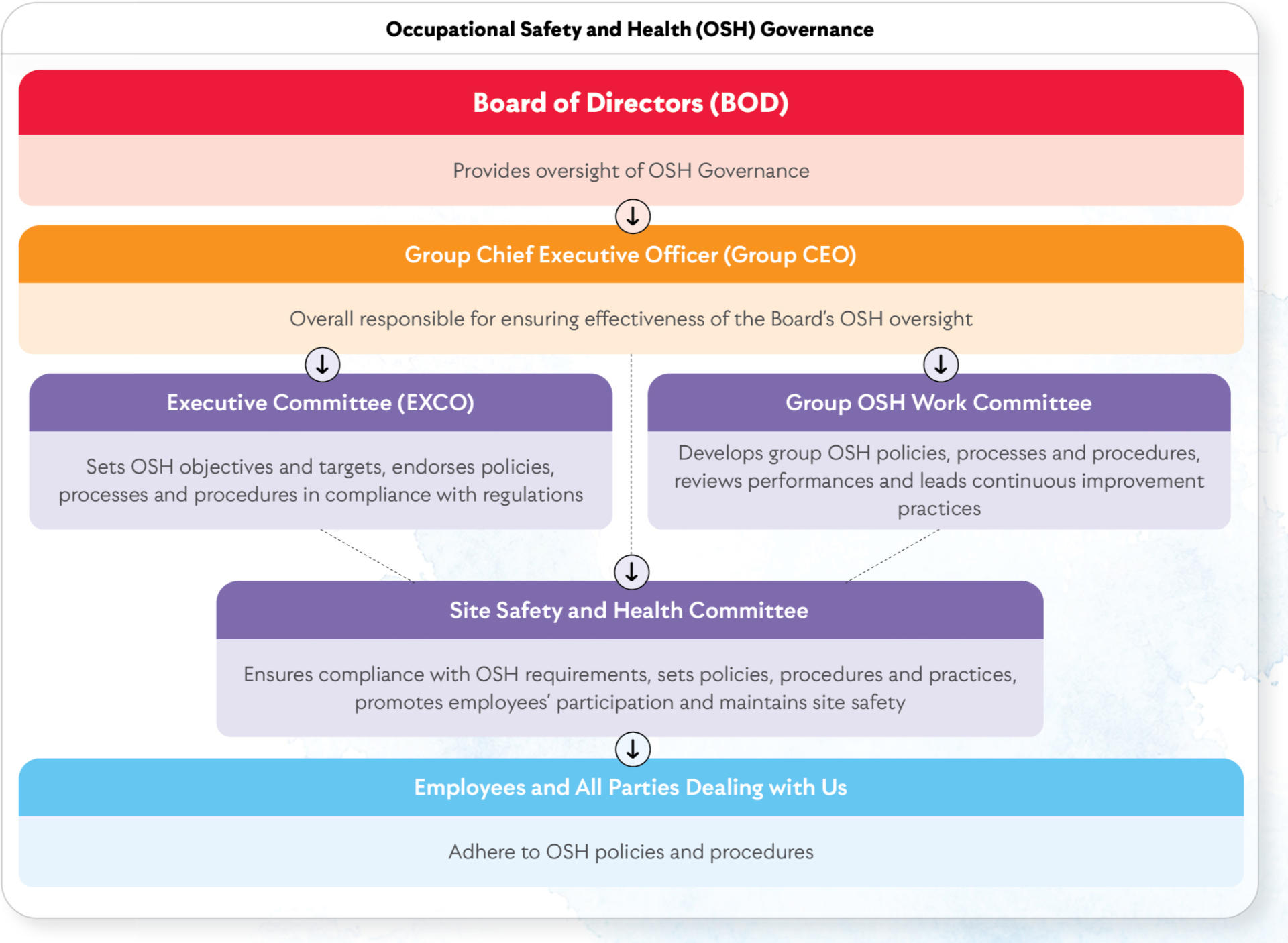
Anchoring our safety commitments is a robust governance, management and accountability structure that ensures safety and health standards are consistently implemented across all levels of the organisation. Clear roles, responsibilities and reporting lines strengthen coordination between management, employees and OSH committees.
With Board-level oversight and leadership accountability embedded across the Group, safety performance is actively managed, regularly reviewed and integrated into key business decisions. The Lost Time Injury Frequency Rate (LTIFR) is a key performance indicator for directors, senior management, line managers and supervisors, and where applicable, is directly linked to the remuneration framework to reinforce accountability and drive sustained focus on safety outcomes.
By embedding OSH into our core business processes and decision-making, and integrating it within our Group’s risk management framework, we demonstrate a firm and sustained commitment to safeguarding our workforce and fostering a safe, healthy and resilient work environment across all our operations.

FY2026 Highlights
-
17.6% of business units certified to ISO 45001:2018,
with ongoing efforts to expand certification and strengthen OSH management system maturity across the Group
-
4,577 employees were trained on health and safety standards
within the reporting year
-
Implemented a group-wide safety campaign
over a three-week period
-
Hazard and Risk Register
is established
-
Two work-related fatalities
were recorded during the year, involving one employee and one contractor. Extensive investigations were conducted, with corrective and preventive actions implemented
-
Lost Time Injury Rate (LTIFR) improved to 2.77,
representing an 11.5% reduction from FY2025, with total lost time injury incidents decreasing from 98 to 87 cases
| Indicator | Unit of Measurement | FY2024 | FY2025 | FY2026 |
| Fatality | Case | 1 | 0 | 2 |
| Lost Time Injury | Case | * 120 | 98 | 87 |
| Non-Lost Time Injury | Case | 258 | 250 | 110 |
| Occupational Illness, Poisoning & Diseases | Case | 2 | 2 | 1 |
| Near-Miss/ Significant Safety Occurrence | Case | 36 | 239 | 96 |
| Non-Compliance (NC) | Case | 1 | 4 | 8 |
| Total Number of Cases | Case | * 418 | 593 | 304 |
| Lost Time Injury Frequency Rate | Per million hours | 4.09 | 3.14 | 2.77 |
| Number of Employees Trained on Health & Safety Standards | Number | 3,480 | 4,250 | 4,577 |
Explore More Social Impact Stories

Caring for the Community
Positive Impact Through Community Engagement and Environmental Responsibility During FY2026, QL channelled RM900,873 into community initiatives, benefiting approximately 4,670 beneficiaries.